
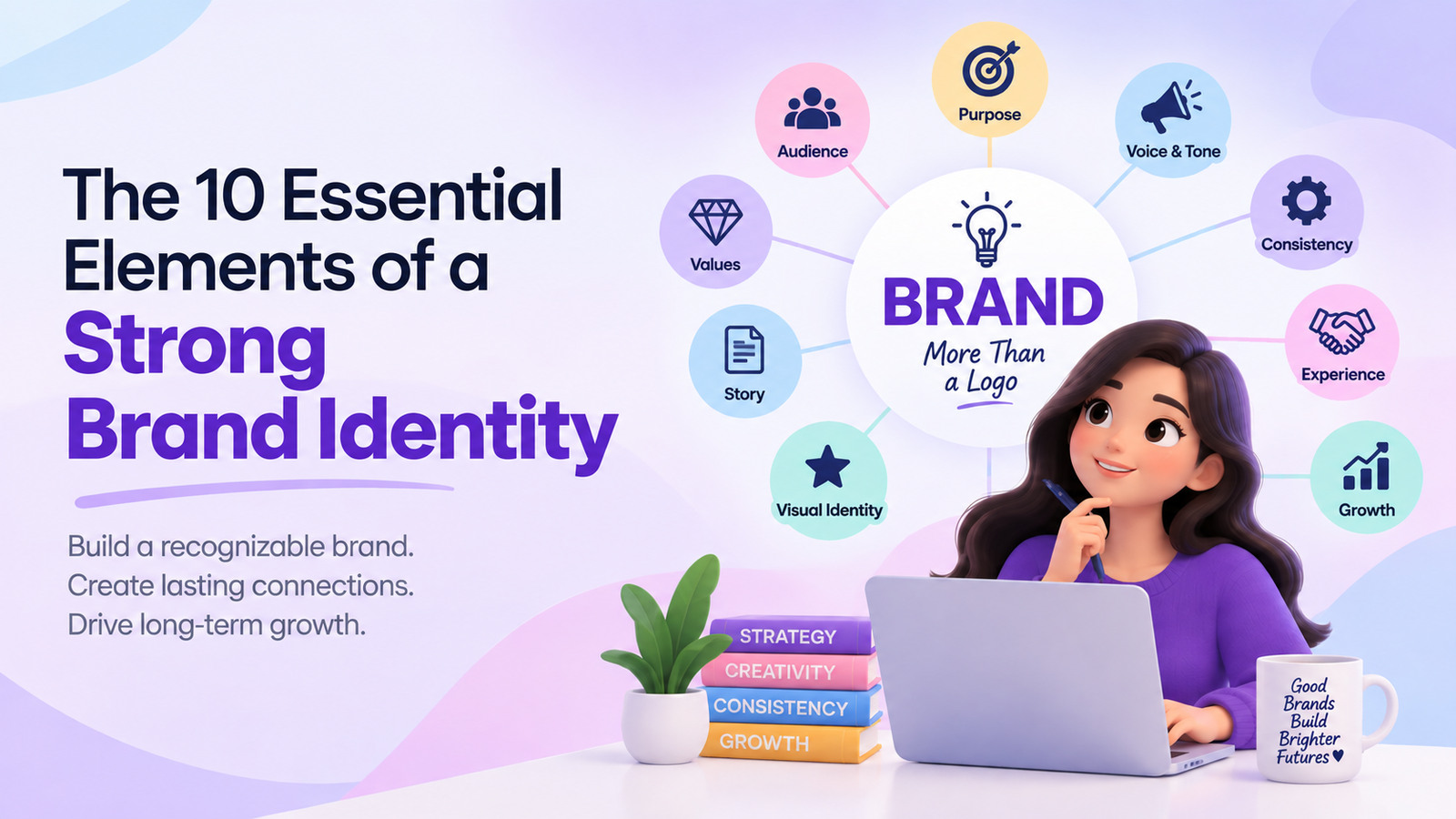
In today’s competitive marketplace, having a good product or service is no longer enough. Businesses need to create a memorable presence that helps customers recognize them, understand what they stand for, and trust their offerings.
This is where brand identity becomes important.
Brand identity is the collection of visual, verbal, and experiential elements that represent a business and shape how it presents itself to the world. From your logo and color palette to your messaging, typography, and tone of voice, every element contributes to how customers perceive your brand.
A strong brand identity creates consistency, builds recognition, communicates personality, and helps businesses differentiate themselves from competitors.
In this blog, we’ll explore the 10 essential elements of a strong brand identity and explain why each one matters.
Brand identity is how a business intentionally presents itself to its audience.
It includes the elements customers can see, hear, read, and experience when interacting with a brand.
These can include:
It is important to distinguish brand identity from brand image.
Brand identity is what a company creates and communicates about itself, while brand image is how customers actually perceive the company.
A strong brand identity helps influence that perception through consistent and meaningful communication.
Every strong brand starts with a clear purpose.
Your brand purpose explains why your business exists beyond simply making money. It provides direction for your messaging, positioning, customer experience, and long-term growth.
For example, a technology company might exist to simplify complex business processes, while a sustainable fashion brand might focus on making environmentally responsible clothing more accessible.
A strong brand purpose should answer:
When your purpose is clearly defined, it becomes easier to create a consistent identity across every customer touchpoint.
Brand positioning defines where your brand sits in the minds of your target customers compared with competitors.
It helps answer a critical question:
Why should customers choose your brand instead of another option?
Effective positioning typically considers:
For example, a company may position itself as:
Without clear positioning, a brand can struggle to communicate what makes it different.
The logo is one of the most recognizable components of a brand identity.
A good logo should be:
Your logo may appear on your website, social media profiles, advertisements, business cards, presentations, packaging, signage, and merchandise.
However, a logo shouldn’t be expected to communicate everything about your business.
Instead, it should work as a recognizable visual signature that operates alongside the rest of your brand identity.
Design your logo so that it remains recognizable in different sizes and applications, including both digital and print formats.
Colors play an important role in visual recognition and emotional associations.
Your brand should have a defined color palette rather than using random colors across different marketing materials.
A typical brand palette may include:
For example, a technology brand might use blue as a primary color and complementary neutral tones to create a professional visual system.
The important thing is not simply choosing colors because they “look good.” Your palette should align with your brand personality, audience, industry, and positioning.
Create clear rules for where each color should be used. This prevents inconsistent designs across websites, social media, advertisements, presentations, and other marketing assets.
Typography is another important component of visual identity.
The fonts you choose influence how your brand communicates visually. A modern sans-serif typeface may create a different impression from an elegant serif typeface.
A strong typography system should define:
For example:
H1: Large and bold
H2: Medium-to-large and prominent
Body: Highly readable
CTA: Clear and visually distinctive
Consistency in typography makes your brand look more professional and helps customers recognize your communication across different platforms.
Brand identity isn’t only visual. Words are an important part of your brand.
Your brand voice defines how your business communicates.
For example, a brand may have a voice that is:
Your voice should remain relatively consistent, while your tone can adapt depending on the situation.
For example, a brand might use a friendly tone in social media posts but a more professional tone in an enterprise proposal.
A brand voice guide can define:
This helps ensure that different teams communicate in a recognizable way.
Brand messaging communicates what your company stands for and why customers should care.
Your messaging framework can include:
What value do you consistently promise customers?
What specific value do customers receive from your product or service?
Can your brand idea be communicated through a short, memorable phrase?
What are the most important ideas you want your audience to remember?
For example, a B2B SaaS company may build its messaging around:
Problem → Solution → Benefit → Differentiator
Instead of simply saying:
“We provide business software.”
The brand could communicate:
“Simplify complex operations with an intelligent platform built to improve visibility, efficiency, and decision-making.”
Strong messaging transforms your brand from a collection of visual elements into a meaningful proposition.
Images can communicate your brand personality faster than words.
Your brand should establish a consistent visual direction for:
For example, a premium consulting brand might use sophisticated professional photography, while a youthful consumer brand might use colorful lifestyle imagery.
Consistency matters more than using the same image style everywhere.
Your visual guidelines should define characteristics such as:
This creates a recognizable visual language across marketing channels.
A strong brand identity shouldn’t stop at the logo or website.
Customers interact with your brand through multiple touchpoints, including:
Each interaction contributes to the overall brand experience.
Imagine a company with a premium website but inconsistent social media, poorly designed sales materials, and an unprofessional customer support experience.
The visual identity might be strong, but the overall brand experience becomes inconsistent.
That’s why businesses should think about brand identity as a system rather than a collection of individual designs.
Finally, a strong brand identity needs documentation.
A brand guidelines document explains how the identity should be used consistently.
A brand guideline may include:
Brand guidelines become particularly important as a business grows and more employees, agencies, freelancers, and partners start creating marketing materials.
A well-developed brand identity can provide several business benefits.
Consistent colors, typography, imagery, messaging, and visual assets make it easier for customers to recognize your business.
A distinctive identity helps your business stand apart in crowded markets.
Consistency signals professionalism and reliability.
Brand guidelines help different teams and channels communicate a unified message.
When customers understand what a brand represents and consistently receive the expected experience, stronger relationships can develop over time.
A documented identity system makes it easier to create new campaigns, products, websites, social media assets, and marketing materials without reinventing the brand every time.
Brand identity is only one part of building a strong brand.
A broader brand strategy may include:
Brand Purpose → Target Audience → Positioning → Value Proposition → Messaging → Brand Identity → Customer Experience
The strategy defines what the brand stands for and how it should compete, while the identity provides the visual and verbal system used to communicate that strategy.
Both need to work together.
If you’re developing a new brand or refreshing an existing one, follow a structured process:
Understand who you’re trying to reach, including their needs, expectations, motivations, and pain points.
Analyze competitor positioning, messaging, visual identity, customer experience, and market differentiation.
Establish your purpose, positioning, values, personality, value proposition, and key messages.
Create your logo, colors, typography, imagery, graphic elements, and other visual assets.
Define your brand voice, tone, messaging framework, tagline, and communication principles.
Create clear rules for how the identity should be used.
Implement the identity across your website, social media, advertising, sales materials, email campaigns, product experiences, and other customer touchpoints.
Brands need consistency, but they also need to evolve as their audiences, products, and markets change.
Even businesses with good products can weaken their identity through inconsistent execution.
Avoid these common mistakes:
The objective isn’t to make every marketing asset identical. The objective is to create a recognizable and coherent brand system.
A strong brand identity is much more than a logo.
It is a coordinated system of strategy, visuals, messaging, personality, and customer experience that helps people recognize and understand your business.
The 10 essential elements are:
When these elements work together, your brand becomes more consistent, recognizable, and differentiated.
Ultimately, successful branding isn’t about creating something that simply looks attractive. It’s about creating an identity that communicates who you are, connects with the right audience, and remains consistent across every interaction.