
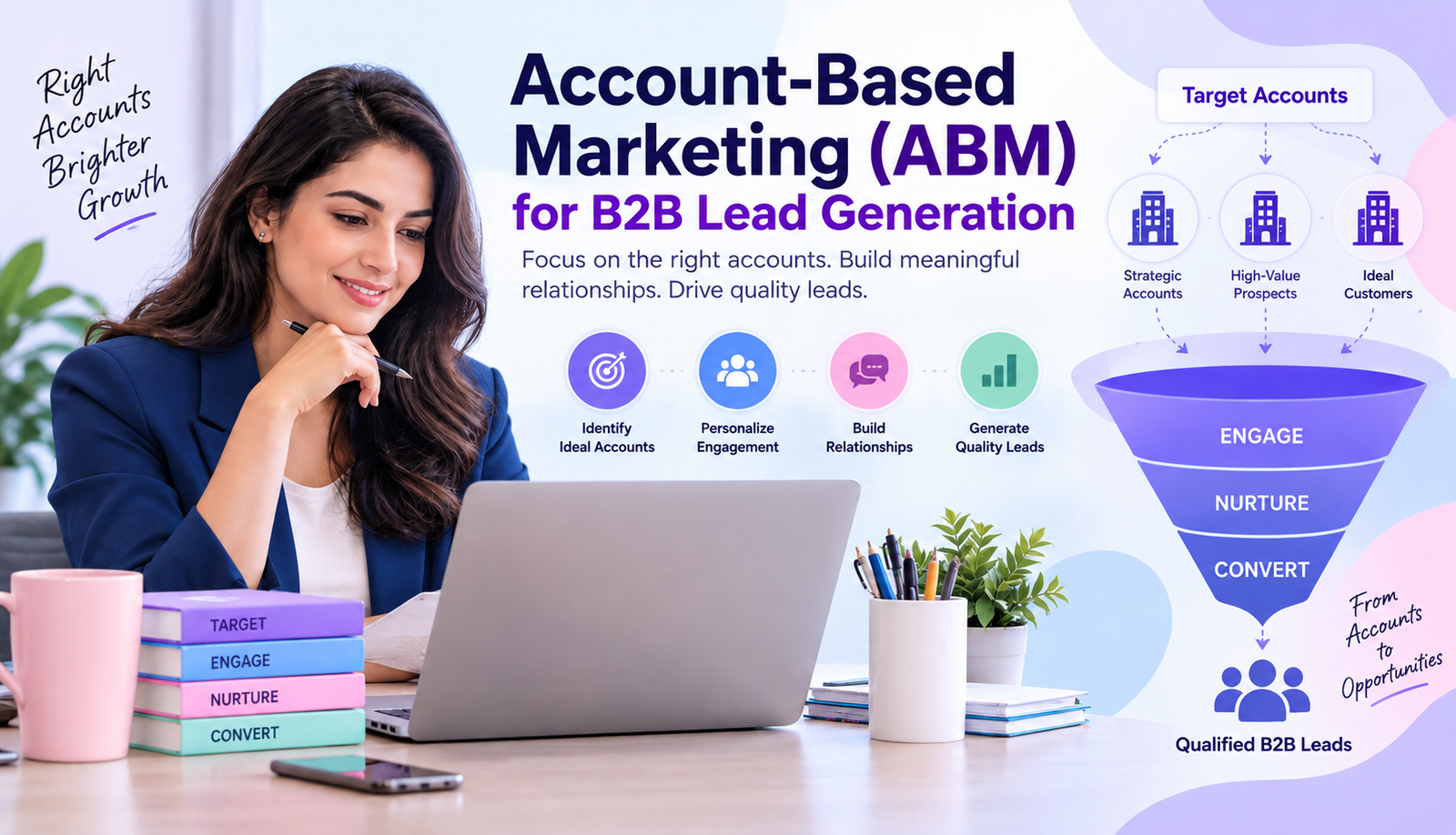
In traditional B2B marketing, businesses often cast a wide net to generate as many leads as possible and then determine which prospects are worth pursuing. Account-Based Marketing (ABM) takes a different approach.
Instead of targeting a large audience and hoping the right prospects convert, ABM identifies specific high-value companies and creates personalized marketing campaigns designed specifically for them.
For B2B organizations selling high-value products or services, ABM can help marketing and sales teams focus their resources on accounts that have the strongest potential to become customers.
In this guide, we’ll explore what ABM is, how it works, the benefits of ABM for B2B lead generation, and how to build an effective ABM strategy.
Account-Based Marketing is a B2B marketing strategy that treats individual companies or organizations as target markets rather than targeting individual leads independently.
The marketing and sales teams work together to identify high-value accounts, understand their business challenges, identify key decision-makers, and deliver personalized campaigns designed to engage those accounts.
For example, instead of running a generic LinkedIn campaign targeting 10,000 IT professionals, a SaaS company could identify 100 specific companies that match its ideal customer profile (ICP).
The company can then create personalized campaigns for:
The objective is not simply to generate more leads. It is to engage the right accounts and move them through the B2B buying journey.
B2B buying decisions are often complex.
A purchase may involve multiple stakeholders, long sales cycles, extensive research, and significant budgets. Generating thousands of unqualified leads does not necessarily result in more revenue.
ABM changes the focus from:
More leads → More opportunities
to:
Right accounts → Right decision-makers → Meaningful engagement → Qualified opportunities
This makes ABM particularly useful for businesses selling:
Traditional demand generation and ABM can work together, but they approach targeting differently.
| Traditional Lead Generation | Account-Based Marketing |
| Targets broader audiences | Targets specific accounts |
| Focuses primarily on individual leads | Focuses on accounts and buying groups |
| High lead volume | Higher account relevance |
| Generic messaging | Personalized messaging |
| Lead qualification follows acquisition | Account selection precedes campaign execution |
| Often marketing-led | Marketing and sales collaboration |
| Measures leads and conversions | Measures account engagement and pipeline |
ABM does not necessarily replace traditional lead generation. Instead, it can complement broader demand-generation activities by focusing additional resources on strategically important accounts.
ABM can generally be implemented at different levels of personalization.
This is the most personalized form of ABM.
Marketing creates a highly customized strategy for an individual target account.
For example, an enterprise software company might identify a large manufacturing company as a strategic prospect and develop:
This approach is usually appropriate for high-value strategic accounts.
Instead of creating campaigns for one company, businesses group several accounts with similar characteristics.
For example:
Segment: Mid-market FMCG companies
Campaign content could focus on:
The messaging is personalized to the segment while remaining scalable.
This approach uses technology and automation to target a larger number of accounts.
For example, a B2B SaaS company could identify 500 companies within its ICP and run:
The messaging is less individualized but still account-focused.
The foundation of ABM is a well-defined Ideal Customer Profile (ICP).
Your ICP describes the type of company that is most likely to benefit from your product or service.
Consider factors such as:
For example:
ICP for a B2B SaaS company
Mid-market and enterprise FMCG companies with 500+ employees, multiple distributors, a large field sales team, and a need for real-time distribution and secondary-sales visibility.
The more precise your ICP, the easier it becomes to identify relevant accounts.
Once the ICP is defined, build a list of companies that match those criteria.
Potential sources include:
Not every account deserves the same level of investment.
Create account tiers based on strategic importance.
Small number of highly valuable accounts.
Use:
Larger account group with strong ICP fit.
Use:
Larger account pool with reasonable ICP fit.
Use:
One of the biggest advantages of ABM is that it recognizes that B2B purchases rarely involve just one person.
A typical buying committee may include:
Each stakeholder may have different priorities.
For example:
CFO: ROI and cost reduction
Sales Head: Revenue growth and sales productivity
IT Head: Security and integration
Operations Head: Process efficiency
Your messaging should reflect these different priorities.
Before launching campaigns, understand the account.
Research:
This research helps identify relevant pain points and buying triggers.
For example, if a company is expanding into multiple new regions, it may be experiencing challenges related to sales operations, supply chain management, or distributor management.
That business event can become an ABM campaign trigger.
Personalization is one of the core principles of ABM.
Instead of sending:
“Learn more about our software.”
Create messaging that connects your solution to the account’s business situation.
For example:
“How FMCG companies can improve distributor visibility across 500+ locations.”
Useful ABM content formats include:
LinkedIn can be an important channel for B2B ABM because businesses can build campaigns around professional attributes and account targeting capabilities.
A typical campaign structure could be:
Target accounts → Job functions → Seniority → Content → Retargeting → Demo
For example:
Accounts: 100 target SaaS companies
Audience:
Campaign 1: Industry report
Campaign 2: Case study
Campaign 3: Webinar
Campaign 4: Product demo
The objective is to create repeated exposure among multiple stakeholders within the same accounts.
Email marketing can support ABM by delivering relevant information to identified contacts.
Instead of using one generic sequence, create different sequences based on:
For example:
Highlight an industry-specific challenge.
Share research or useful information.
Provide a relevant case study.
Explain how the product addresses the challenge.
Offer a demo, consultation, assessment, or meeting.
Your website can also become part of your ABM strategy.
Create personalized landing pages based on:
Industry
Distribution Management Software for FMCG Companies
Company Size
Enterprise Sales Management Solutions
Business Challenge
Improve Secondary Sales Visibility
Use Case
Automate Distributor Order Management
These landing pages can improve message relevance and support account-specific campaigns.
ABM works best when sales and marketing operate from the same account strategy.
Marketing should provide sales with:
Sales can then prioritize outreach based on account engagement.
For example:
Account X has visited three product pages, downloaded an eBook, attended a webinar, and engaged with LinkedIn ads.
This is more actionable than simply knowing that one person submitted a form.
A practical ABM funnel can look like this:
1. Identify Accounts
↓
2. Research Accounts
↓
3. Identify Buying Committee
↓
4. Launch Personalized Campaigns
↓
5. Generate Engagement
↓
6. Identify Intent Signals
↓
7. Sales Outreach
↓
8. Book Meetings
↓
9. Create Opportunities
↓
10. Close & Expand Accounts
The key difference is that the funnel is measured at both contact and account level.
A successful ABM program can use multiple channels.
Useful for:
Useful for:
Useful for:
Useful for:
Useful for:
Useful for maintaining visibility among accounts that have already interacted with your brand.
Useful for converting account engagement into direct conversations.
Traditional lead-generation metrics alone are not sufficient for measuring ABM.
Track metrics across the entire account journey.
How many target accounts are being reached?
Formula:
Account Coverage = Accounts Reached ÷ Target Accounts × 100
Measure activities such as:
Instead of only tracking MQLs, identify accounts showing meaningful engagement.
For example:
35 out of 200 target accounts reached the predefined engagement threshold.
Track meetings generated from target accounts.
Measure the pipeline value associated with target accounts.
Formula:
Account Conversion Rate = Converted Accounts ÷ Engaged Accounts × 100
Ultimately, ABM should be connected to revenue.
Track:
A typical B2B ABM technology stack can include:
The exact technology stack should depend on the organization’s account volume, sales cycle, budget, data quality, and operational maturity.
To build a scalable ABM program, focus on the following principles:
Define exactly which accounts you want to acquire.
A smaller list of relevant accounts can be easier to manage than a very large, loosely defined list.
Combine account-level personalization with stakeholder-level messaging.
Reach target accounts through a combination of paid media, email, content, website experiences, and sales outreach.
Establish shared definitions, account ownership, engagement thresholds, and handoff processes.
Monitor meaningful signals rather than relying exclusively on form submissions.
Measure pipeline and revenue contribution, not just clicks and leads.
Account-Based Marketing provides a structured approach to B2B lead generation by focusing marketing and sales resources on specific high-value accounts.
Rather than maximizing lead volume, ABM focuses on account relevance, stakeholder engagement, personalization, and measurable business outcomes.
A successful ABM program typically combines:
Strong ICP + Target Account List + Buying Committee Mapping + Personalized Content + Multi-Channel Campaigns + Sales Alignment + Account-Level Measurement
For B2B companies with complex buying journeys, ABM can become an important component of a broader demand-generation strategy.
The key is to start with a clearly defined target-account strategy, build relevant experiences for those accounts, and continuously optimize campaigns based on engagement, pipeline, and revenue data.