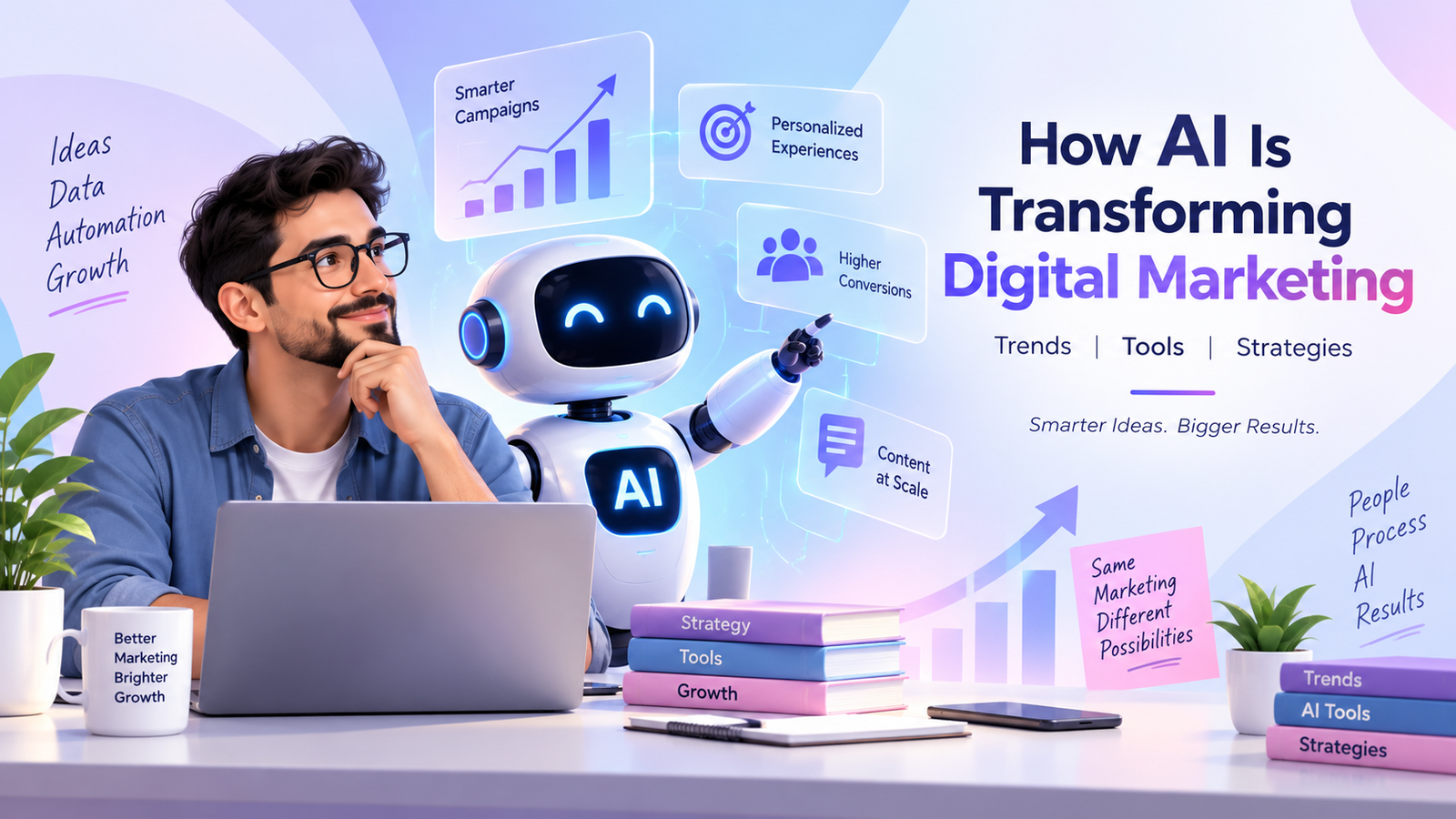
Artificial intelligence (AI) is rapidly changing the way businesses approach digital marketing. From generating content and analyzing customer behavior to optimizing advertising campaigns and delivering personalized experiences, AI is becoming an integral part of modern marketing strategies.
What once required hours of manual research, analysis, segmentation, and optimization can now be accelerated with AI-powered tools and automation. However, AI is not simply replacing traditional marketing activities. It is helping marketers make faster, more informed, and more data-driven decisions.
In this article, we explore how AI is transforming digital marketing, the latest AI marketing trends, popular tools, and practical strategies businesses can use to improve their digital growth.
AI in digital marketing refers to the use of artificial intelligence technologies to automate tasks, analyze data, understand customer behavior, generate content, optimize campaigns, and improve marketing outcomes.
AI systems can process large amounts of data and identify patterns that may be difficult to detect manually. Marketers can use these insights to understand their audiences, predict customer behavior, personalize communication, and optimize marketing campaigns.
Some common applications of AI in digital marketing include:
The result is a shift from simply executing marketing activities to building intelligent, automated, and data-driven marketing systems.
Digital marketing generates enormous amounts of data. Websites, social media platforms, advertising platforms, CRM systems, email campaigns, and analytics tools all produce valuable customer information.
The challenge is turning this information into actionable insights.
AI can help marketers:
AI can process large datasets quickly and identify patterns in customer behavior, campaign performance, website activity, and conversions.
Instead of delivering the same message to every visitor, businesses can use AI to personalize content, recommendations, offers, and communication based on customer behavior.
Tasks such as email segmentation, reporting, lead scoring, content ideation, and campaign monitoring can be partially automated.
AI can identify high-performing audiences, creatives, keywords, placements, and campaigns and help marketers allocate resources more efficiently.
AI-powered chatbots and conversational interfaces can provide immediate responses and guide users toward relevant information or actions.
Generative AI has become one of the most visible applications of AI in marketing.
Marketers can use generative AI to assist with:
Tools such as ChatGPT, Google Gemini, Claude, and other generative AI platforms can significantly accelerate the content development process.
However, effective content marketing still requires human oversight.
AI-generated content should be reviewed for:
The future is not simply AI-generated content. It is AI-assisted content strategy combined with human expertise.
AI is changing how marketers approach search engine optimization.
Traditional SEO primarily focused on keywords, backlinks, technical optimization, and rankings. These remain important, but search behavior is becoming increasingly conversational and AI-driven.
Marketers now need to consider:
AI tools can help marketers identify keyword opportunities, analyze search results, develop content briefs, identify content gaps, and organize large keyword datasets.
The bigger shift is that marketers increasingly need to optimize content not only for traditional search engines but also for AI-powered discovery experiences.
Personalization has moved beyond simply adding a customer’s first name to an email.
AI can analyze behavioral signals such as:
These signals can be used to personalize marketing experiences.
For example, an e-commerce company can recommend products based on previous browsing and purchasing behavior.
A B2B SaaS company can display different content depending on whether the visitor is a first-time visitor, marketing-qualified lead, or existing customer.
AI makes this personalization possible at a much larger scale.
Advertising platforms are increasingly using machine learning and AI to automate bidding, targeting, audience optimization, creative combinations, and campaign delivery.
Platforms such as Google Ads and Meta provide automated campaign optimization capabilities that can analyze signals and adjust campaign delivery based on defined objectives.
AI can also help marketers with:
Instead of manually optimizing every campaign element, marketers can increasingly focus on strategy, positioning, creative direction, experimentation, and business outcomes.
AI-powered chatbots are transforming how businesses interact with website visitors.
Traditional chatbots often relied on predefined decision trees. Modern conversational AI can understand natural language and respond to more complex questions.
Businesses can use conversational AI for:
For example, a B2B software company can use an AI chatbot to answer product questions, identify the visitor’s business requirements, and direct qualified prospects toward a demo.
This can help reduce response times while supporting sales and customer service teams.
One of AI’s most valuable applications for B2B marketers is predictive analytics.
AI can analyze historical customer data to identify patterns associated with conversion or churn.
Marketing teams can use these insights for:
For example, an AI-powered lead scoring system can identify prospects that demonstrate behaviors associated with high purchase intent.
Sales teams can then prioritize those prospects instead of treating every lead equally.
AI is making email marketing more intelligent and personalized.
AI can help marketers determine:
AI can also support automated email journeys based on user behavior.
For example:
Website visit → Content download → Email nurture → Product demo → Sales follow-up
AI can help determine the next relevant communication based on the customer’s interaction with previous messages.
Managing multiple social media channels requires significant time and resources.
AI can assist with:
AI can also help marketers transform one piece of long-form content into multiple social media assets.
For example:
One blog → LinkedIn post → Instagram carousel → Short video script → Email newsletter
This allows marketing teams to increase content output without creating every asset from scratch.
Customer journeys are becoming increasingly complex.
A potential customer may interact with a business through:
Google Search → Website → LinkedIn → Webinar → Email → Retargeting Ad → Demo → Sales Call
AI can analyze interactions across these touchpoints and identify patterns in the customer journey.
Marketers can use these insights to determine:
This enables businesses to move from channel-level optimization toward customer journey optimization.
One of the emerging developments in AI marketing is the rise of AI agents.
Unlike traditional automation, which follows predefined workflows, AI agents can potentially interpret goals, gather information, make decisions, and execute multiple steps within a workflow.
Marketing applications may include:
For example, an AI-driven workflow could:
Identify a target account → Research the company → Identify relevant decision-makers → Personalize messaging → Add prospects to a CRM → Trigger an outreach sequence.
Human oversight remains important, particularly for brand, compliance, data privacy, and customer-facing communication.
There is now a growing ecosystem of AI-powered marketing tools.
The right tool depends on the organization’s goals, budget, technology stack, data availability, and marketing maturity.
The objective should not be to adopt as many AI tools as possible. It should be to identify specific marketing problems that AI can solve efficiently.
Implementing AI successfully requires more than subscribing to an AI tool.
Here is a practical framework.
Start by identifying activities that consume significant time.
For example:
Prioritize tasks where automation can create measurable efficiency.
AI should support business outcomes rather than become a technology experiment.
Define objectives such as:
AI is only as useful as the data supporting it.
Evaluate your:
Clean, structured, and reliable data provides a stronger foundation for AI-driven marketing.
Choose tools based on your existing marketing technology stack.
For example:
CRM + AI → Lead scoring and personalization
SEO platform + AI → Content research and optimization
Marketing automation + AI → Behavioral workflows
Analytics + AI → Performance insights
Avoid adopting tools simply because they are popular.
AI should support marketers rather than eliminate human judgment from important decisions.
A strong workflow is:
AI → Analyze → Recommend → Human Review → Execute → Measure
Human marketers should remain responsible for strategic decisions, brand positioning, creative direction, factual verification, and sensitive customer communication.
Consider a B2B SaaS company that wants to generate more qualified leads.
An AI-enabled marketing system could look like this:
AI identifies relevant search topics and audience interests.
↓
AI assists marketers in creating blogs, whitepapers, case studies, and social content.
↓
SEO and paid campaigns attract relevant prospects.
↓
Website content changes based on visitor intent and lifecycle stage.
↓
AI chatbot qualifies visitors and captures relevant information.
↓
AI analyzes engagement and identifies high-intent prospects.
↓
Marketing automation delivers personalized email sequences.
↓
High-intent leads are routed to sales.
↓
AI analyzes campaign performance and identifies optimization opportunities.
This creates a connected AI-assisted demand generation engine.
AI is transforming digital marketing from a collection of manually managed channels into a more intelligent, automated, and data-driven ecosystem.
From content creation and SEO to paid advertising, personalization, lead scoring, customer support, and marketing automation, AI can improve almost every stage of the customer journey.
However, successful AI marketing is not about replacing marketers with machines.
It is about combining AI’s speed, scalability, and analytical capabilities with human creativity, strategic thinking, judgment, and empathy.
Businesses that approach AI strategically—rather than simply chasing the latest tools—can build more efficient marketing operations, deliver better customer experiences, and create scalable digital growth.
The key question is no longer:
“Should we use AI in marketing?”
The more important question is:
“Where can AI create the greatest measurable impact across our marketing funnel?”
That is where the real opportunity lies.