
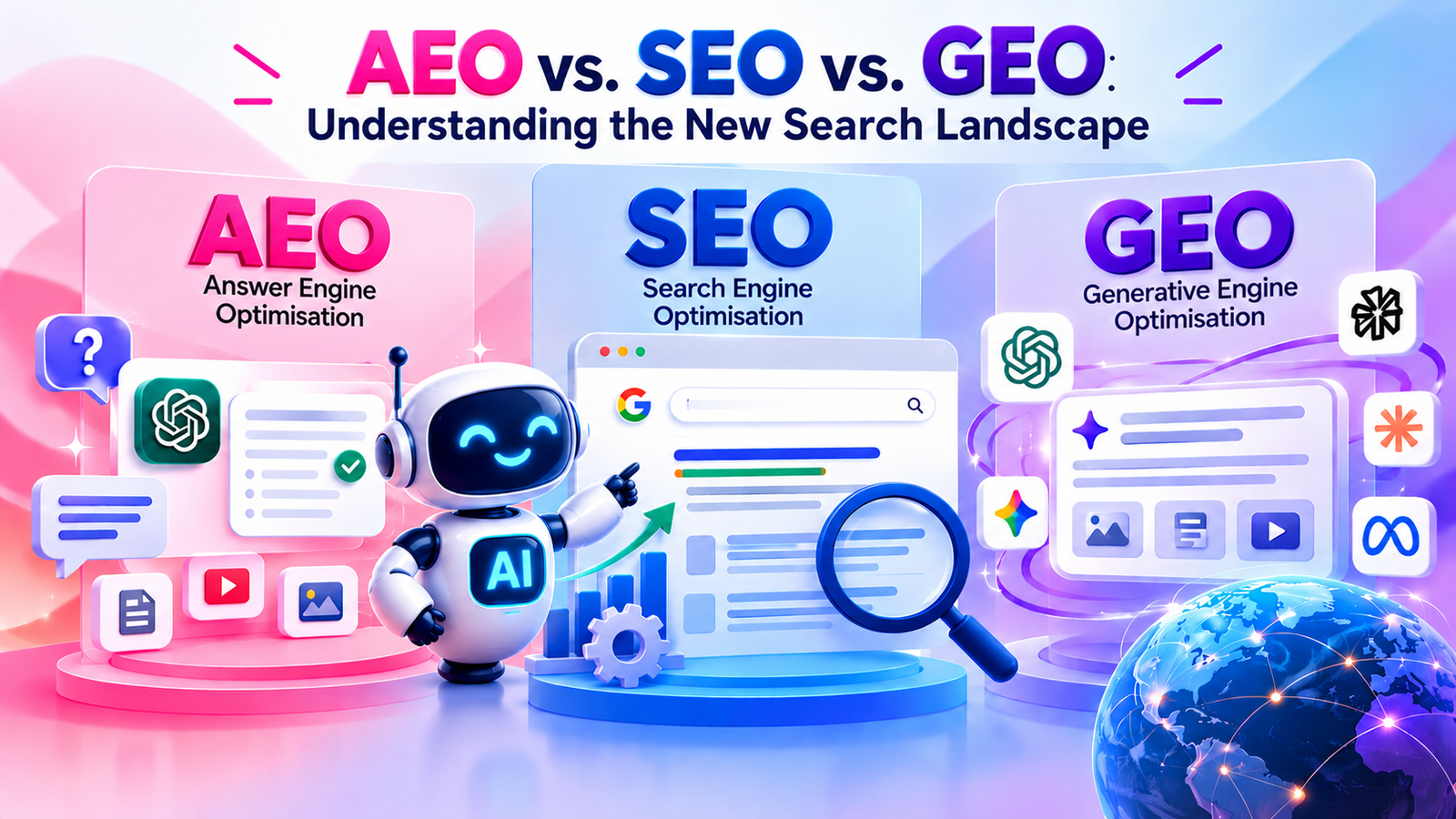
Search is changing rapidly. For years, businesses focused primarily on Search Engine Optimization (SEO) to improve their visibility on Google and other traditional search engines. Today, users are increasingly turning to AI-powered search experiences, conversational assistants, and generative search platforms to discover information, products, services, and brands.
This shift has introduced two important concepts: Answer Engine Optimization (AEO) and Generative Engine Optimization (GEO).
While SEO, AEO, and GEO overlap in several areas, they address different search experiences and optimization goals.
Understanding the differences between them—and how they work together—is becoming increasingly important for businesses that want to remain visible across the evolving search landscape.
Search Engine Optimization (SEO) is the practice of improving a website and its content so that search engines can understand, index, and rank it for relevant queries.
Traditional SEO focuses heavily on search engine results pages (SERPs), particularly organic rankings.
Key SEO activities include:
For example, if someone searches for:
“Best digital marketing strategies for small businesses”
An SEO-focused strategy would aim to make a relevant website page appear prominently in the organic search results.
Improve organic visibility and drive qualified traffic from traditional search engines.
SEO remains fundamental because search engines still rely heavily on websites, structured information, authority signals, and content quality to understand the web.
Answer Engine Optimization (AEO) focuses on optimizing content so that it can provide direct, concise answers to users’ questions.
Instead of focusing only on ranking a webpage, AEO considers situations where a search engine or answer engine provides an answer directly to the user.
AEO is particularly relevant for queries such as:
AEO content is typically structured to make answers easy for search systems to identify and extract.
1. Answer questions directly
Provide a concise answer near the beginning of a section before expanding on the topic.
2. Build FAQ sections
Frequently asked questions create clearly defined question-and-answer relationships.
3. Use structured content
Headings, lists, tables, definitions, and step-by-step explanations make information easier to interpret.
4. Match conversational queries
Optimize for natural-language questions rather than relying exclusively on short keywords.
5. Demonstrate topical expertise
Create comprehensive content that covers related questions and subtopics.
Increase the likelihood that your content is used to answer a user’s question directly.
Generative Engine Optimization (GEO) refers to optimizing a brand’s digital presence and content so that it has a better chance of being discovered, understood, and represented accurately in AI-generated responses.
Generative search experiences can synthesize information from multiple sources rather than simply displaying a conventional list of links.
Examples include AI-powered search and conversational systems that generate summaries, comparisons, recommendations, or explanations.
For example, a user might ask:
“Which digital marketing agency should a SaaS company consider for B2B lead generation?”
Instead of returning only ten blue links, a generative search system may synthesize information from multiple websites and mention several companies within its response.
This creates a new visibility challenge:
How does your brand become part of the information that AI systems use to construct an answer?
Increase a brand’s visibility and representation within AI-generated search experiences.
Although the three approaches overlap, their primary objectives differ.
| Factor | SEO | AEO | GEO |
| Full form | Search Engine Optimization | Answer Engine Optimization | Generative Engine Optimization |
| Primary focus | Search rankings | Direct answers | AI-generated responses |
| Main objective | Generate organic traffic | Become a useful answer source | Increase visibility in generative results |
| Typical output | Search results and website visits | Direct answers/snippets | AI-generated summaries and recommendations |
| Content emphasis | Relevance, authority, technical quality | Clarity and question-answer structure | Authority, context, factual accuracy and brand/entity signals |
| Important formats | Articles, landing pages, product pages | FAQs, definitions, concise answers | Research, expert content, structured information, authoritative resources |
| Success indicators | Rankings, impressions, organic traffic | Featured visibility, answer inclusion, question coverage | Brand mentions, citations, references and visibility in AI responses |
The important point is that SEO, AEO, and GEO are not mutually exclusive strategies.
A strong content asset can potentially support all three.
Traditional search generally follows a familiar model:
User query → Search engine → Ranked results → Website visit
Generative search introduces another model:
User query → AI system → Synthesized response → Sources/citations and follow-up interaction
This changes how users discover information.
A user may no longer need to visit several websites to compare products, understand a concept, or find an answer. Instead, an AI system may summarize information from multiple sources and provide an answer within the search experience.
This means businesses need to think beyond simply:
“How do I rank #1?”
The broader question becomes:
“How do I make my content useful, authoritative, understandable, and discoverable across different search experiences?”
Rather than treating SEO, AEO, and GEO as competing strategies, businesses should view them as interconnected layers.
Start with strong technical foundations and content optimized around relevant search intent.
This includes:
Once your content is discoverable, organize it so that important questions can be answered clearly.
For example:
Question: What is account-based marketing?
Direct answer: Account-based marketing is a B2B strategy that focuses marketing and sales efforts on specific high-value accounts rather than targeting a broad audience.
The explanation can then expand into examples, benefits, implementation steps, and related questions.
Finally, make your content valuable as a source of information for generative systems.
This requires going beyond keyword placement.
Consider:
This creates a more comprehensive search visibility strategy.
Content remains central to all three approaches—but the definition of effective content is changing.
A modern content strategy should combine search optimization, answer optimization, and information authority.
For example, consider an article titled:
“Complete Guide to B2B Lead Generation.”
An SEO-oriented article might target keywords such as:
An AEO-oriented version could additionally answer:
A GEO-oriented strategy would go further by incorporating:
One well-developed resource can therefore serve multiple search environments.
Don’t begin with keywords alone.
Understand what the user actually wants.
Search intent can include:
For example, someone searching “what is marketing automation” has a different intent from someone searching “best marketing automation software for SaaS.”
Your content should reflect that difference.
Don’t make readers—or search systems—dig through several paragraphs before finding the answer.
Use a concise definition or answer near the beginning of important sections.
Then provide deeper context.
This improves both usability and answer extraction.
Instead of publishing isolated articles, build interconnected content around important topics.
For example:
Pillar page:
B2B Lead Generation
Supporting content:
Internal links can help establish relationships between these topics.
Generic information is increasingly easy to generate.
Original information can provide greater value.
Consider publishing:
Original research can also create opportunities for other websites to reference your work.
Google’s quality framework emphasizes Experience, Expertise, Authoritativeness, and Trustworthiness (E-E-A-T).
Businesses should therefore make expertise visible.
Consider including:
This is useful not only for traditional search but for establishing overall information credibility.
Use:
Good structure benefits both human readers and machines processing your content.
Generative systems need to understand who you are, what you do, and how your brand relates to specific topics.
Maintain consistent information across:
Consistency can help reduce ambiguity around your brand and its areas of expertise.
The emergence of AEO and GEO doesn’t make technical SEO irrelevant.
A website still needs to be:
A technically weak website can undermine even excellent content.
The traditional SEO dashboard is no longer enough for every organization.
Track:
Consider monitoring:
Generative search measurement is still evolving, so there is no single universal GEO KPI framework.
Potential indicators include:
Because AI search systems can produce different responses depending on query wording, location, user context, model, and time, GEO measurement requires careful methodology.
GEO is not simply inserting keywords into content for AI systems.
Useful content still needs to be accurate, relevant, well-supported, and valuable to humans.
SEO remains the foundation of organic discoverability.
AEO and GEO should complement—not automatically replace—SEO.
Producing hundreds of similar articles does not automatically create authority.
Focus on originality, usefulness, expertise, and evidence.
A brand’s digital footprint extends beyond its own domain.
Industry publications, reviews, interviews, partnerships, directories, and other authoritative references can contribute to how a business is understood online.
A page can rank well without generating meaningful business outcomes.
Measure the complete journey:
Visibility → Engagement → Leads → Opportunities → Revenue
Search is also moving beyond traditional text-based queries.
Users increasingly interact with digital systems through:
This means future optimization will increasingly involve making information understandable across multiple formats and interfaces.
For marketers, this creates an important shift:
Search optimization is becoming information optimization.
The objective is not simply to optimize a webpage for one search engine. It is to make your organization’s information easy to discover, understand, trust, and reference across digital environments.
Businesses can use the following framework to build a unified strategy.
Determine the subjects your brand should be associated with.
Identify the questions, problems, comparisons, and solutions your audience is looking for.
Create pillar pages and supporting content around each core topic.
Apply technical SEO, on-page optimization, internal linking, and authority-building practices.
Add direct answers, FAQs, definitions, lists, tables, and structured sections.
Include research, data, case studies, expert commentary, and first-hand insights.
Build credible mentions and consistent information across relevant third-party platforms.
Track traditional search performance alongside emerging AI-driven discovery.
Review important pages to ensure facts, statistics, examples, products, and recommendations remain current.
Ultimately, visibility should support meaningful outcomes such as qualified traffic, leads, pipeline, sales, and customer acquisition.
For most businesses, the answer isn’t to choose just one.
A more sustainable approach is to build a unified search visibility strategy:
SEO helps your website become discoverable in traditional search.
AEO helps your content provide direct answers to user questions.
GEO focuses on making your information useful and discoverable within generative search experiences.
Together, they create a broader approach to digital visibility.
The search landscape is moving from a model dominated by ranked webpages toward a more diverse ecosystem involving traditional search engines, answer engines, and generative AI systems.
SEO remains essential, but marketers increasingly need to consider how their content performs beyond conventional rankings.
The future belongs to content that is:
Rather than viewing SEO, AEO, and GEO as separate disciplines, businesses should build a connected strategy that prepares their content for multiple forms of search.
The fundamental principle remains simple:
Create information that people find useful—and make that information easy for search and AI systems to understand, verify, and surface.