
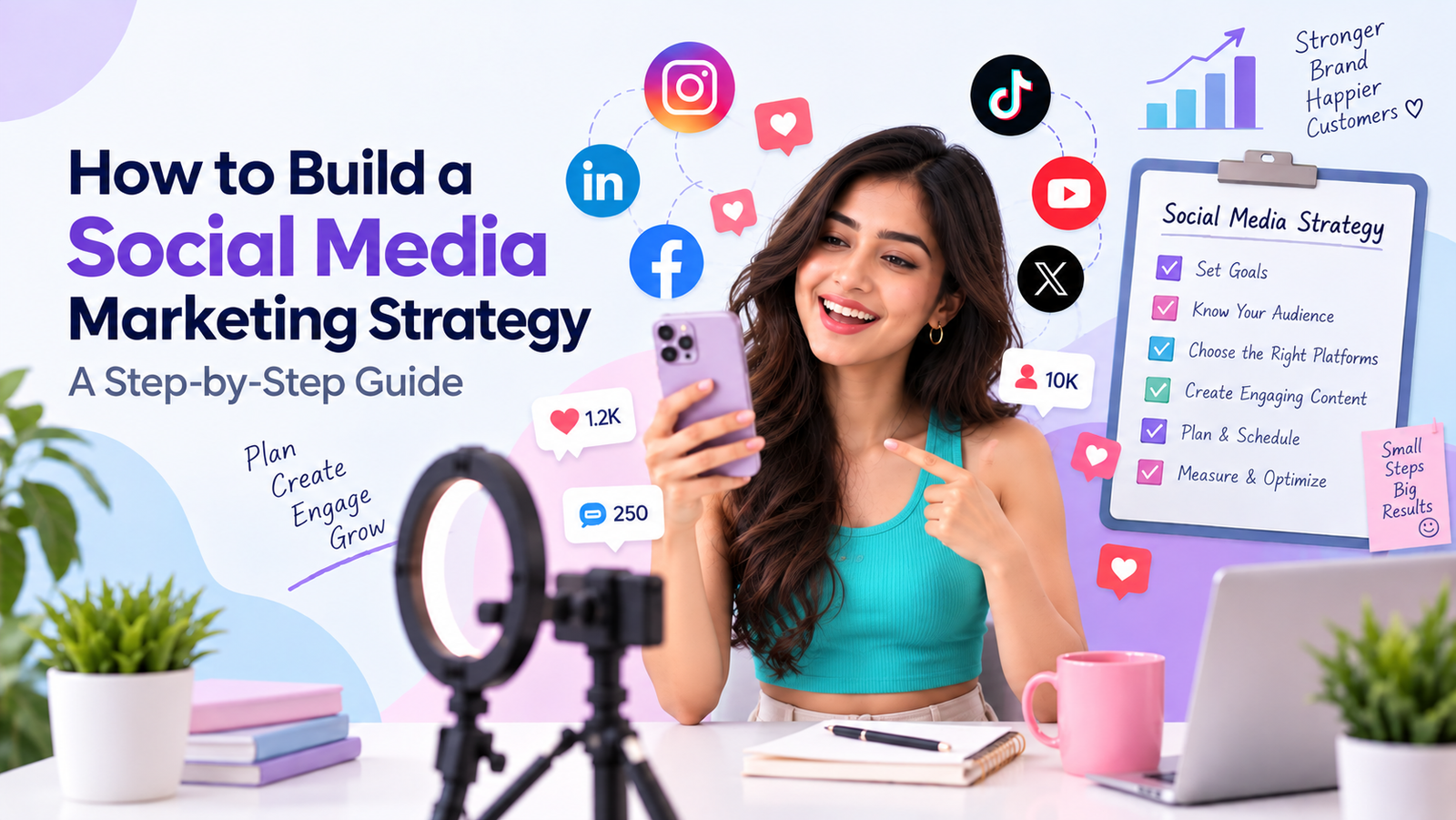
Social media has become one of the most important channels for businesses to build brand awareness, engage customers, generate leads, and drive sales. However, simply posting content regularly is not enough. Businesses need a well-defined social media marketing strategy that connects their content, audience, channels, and business objectives.
A strategic approach helps you move from random posting to purposeful marketing—where every post, campaign, and interaction contributes to a measurable business goal.
In this guide, we’ll explore how to build a social media marketing strategy from the ground up, including audience research, platform selection, content planning, paid advertising, community engagement, and performance measurement.
A social media marketing strategy is a structured plan that defines how a business will use social media platforms to achieve its marketing and business objectives.
It typically covers:
A good strategy answers five fundamental questions:
Who are we trying to reach?
What do we want to achieve?
Where should we reach our audience?
What content should we create?
How will we measure success?
The first step is to establish clear goals.
Avoid vague objectives such as:
“We want to grow our social media presence.”
Instead, define specific and measurable goals.
For example:
Your objectives should ideally be:
Specific – Clearly defined
Measurable – Supported by metrics
Achievable – Realistic with available resources
Relevant – Connected to business objectives
Time-bound – Have a defined timeframe
For example:
“Generate 100 qualified B2B leads from LinkedIn over the next 90 days.”
This is much more actionable than simply saying:
“Increase LinkedIn leads.”
Your social media strategy should be built around your audience—not around the platforms you happen to use.
Start by defining your ideal customer.
Consider:
For B2B businesses, you may also need to understand:
For example:
Persona: Marketing Manager
Having detailed personas makes it easier to create content that resonates with the right people.
Before building a new strategy, evaluate what you are already doing.
Conduct a social media audit across your existing channels.
Look at:
Also examine your competitors.
Look at:
The objective isn’t to copy competitors. Instead, identify content gaps and opportunities that your brand can own.
The right platform depends on your:
Common Platform Uses
For example, a B2B SaaS company may prioritize LinkedIn, YouTube, and its blog, while a fashion brand may place greater emphasis on Instagram, Pinterest, and Facebook.
It is usually better to manage two or three platforms effectively than to maintain six platforms with inconsistent content.
Content is the foundation of social media marketing.
Your content strategy should define:
A useful approach is to create several content pillars.
For a digital marketing agency:
1. Educational Content
2. Industry Insights
3. Case Studies
4. Brand Content
5. Promotional Content
This creates variety while maintaining consistency.
Social media users consume content in different ways. Your strategy should therefore include multiple formats.
Consider using:
Examples:
Useful for:
Useful for:
Examples:
Examples:
A strong strategy combines different formats rather than relying exclusively on one.
A content calendar helps your team organize and execute your strategy consistently.
Planning content in advance also helps maintain a consistent publishing schedule.
Make a content calendar for 5 days of the week with the various posts and platforms to target each day. Also, plan the frequency of posts on the various platforms.
Social media is highly visual, so your creative assets should follow a consistent design system.
Define:
Your social media posts should feel like they belong to the same brand even when users encounter them across different platforms.
Consistency matters more than simply posting a large volume of content.
Your posting schedule should be based on:
Instead of blindly following generic recommendations such as “post every day,” analyze your own data to determine when your audience is most responsive.
For example:
LinkedIn: 3–5 posts per week
Instagram: 3–5 posts per week
YouTube: 2–4 videos per month
These are starting points, not universal rules.
The most important factor is whether you can maintain quality and consistency.
Social media is not simply a broadcasting channel.
If you only publish content without interacting with your audience, you are missing a major part of social media marketing.
Engage with:
For example, instead of simply posting:
“5 SEO tips for businesses.”
You could encourage discussion with:
“Which SEO challenge is your business struggling with right now?”
Questions, polls, discussions, and user-generated content can help turn an audience into a community.
Organic social media can build awareness and engagement, while paid advertising can help you reach specific audiences at scale.
Paid social campaigns can support objectives such as:
Awareness
LinkedIn/Meta → Educational content → Website
↓
Consideration
Retargeting → Case study → Webinar
↓
Conversion
Lead generation campaign → Landing page → Demo request
↓
Nurturing
Email → Product content → Sales conversation
This approach connects social media activity with the broader marketing funnel.
Your social media strategy shouldn’t stop at engagement.
Build a journey from awareness to conversion.
Content:
Goal: Reach and brand awareness
Content:
Goal: Engagement and lead generation
Content:
Goal: Leads and sales
Content:
Goal: Customer retention and advocacy
You cannot improve what you don’t measure.
Your KPIs should be connected to your objectives.
Avoid focusing exclusively on vanity metrics such as follower count. A smaller audience that consistently generates qualified leads can be more valuable than a large audience with little commercial engagement.
Use analytics tools provided by the platforms along with your website analytics platform to understand what happens after users click your social content.
Analyze:
For example:
If LinkedIn generates:
10,000 impressions → 500 clicks → 50 leads → 10 customers
while another channel generates:
50,000 impressions → 300 clicks → 10 leads → 1 customer
the raw reach numbers tell only part of the story.
You need to evaluate performance throughout the funnel.
Your social media strategy should evolve based on data, market changes, audience behavior, and platform developments.
Conduct a monthly or quarterly review.
Ask:
A strategy that worked six months ago may not perform the same way today.
A successful social media marketing strategy is not about posting more content. It is about creating the right content, for the right audience, on the right platforms, with a clear business objective behind it.
The most effective approach is to build a repeatable process:
Research → Define Goals → Identify Audience → Choose Platforms → Create Content → Publish → Engage → Promote → Measure → Optimize
When social media is connected to your broader marketing funnel, it can become much more than a brand awareness channel. It can support lead generation, customer engagement, website traffic, sales, and long-term brand growth.
The key is to treat social media as a strategic marketing channel—not simply as a content publishing platform.